How LED Track Light Reduces Energy Costs for Commercial Spaces
Energy efficiency has become a top priority for commercial buildings, retail stores, galleries, offices, and hospitality venues. Rising electricity costs, stricter environmental regulations, and sustainability goals are driving businesses to rethink their lighting systems.
Among the most effective solutions is the LED track light system—a flexible, high-efficiency lighting solution that not only improves visual performance but also significantly reduces operational costs.
In this comprehensive guide, we will analyze how LED track lights reduce energy costs in commercial spaces, covering technical factors, real-world applications, and financial benefits.
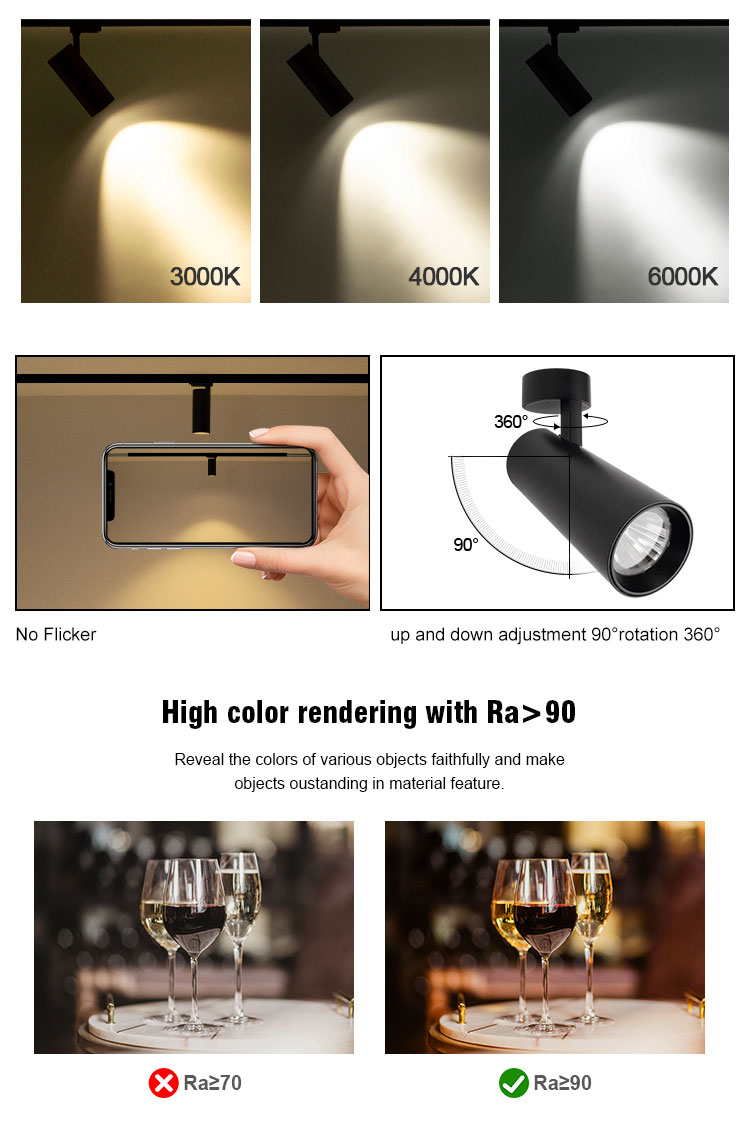
1. What Is an LED Track Light System?
An LED track lighting system consists of:
- A track rail (power supply line)
- Adjustable LED light heads
- Integrated drivers
- Mounting accessories
Unlike fixed lighting, track lights can be repositioned along the rail, allowing precise control over illumination.
They are widely used in:
- Retail stores
- Shopping malls
- Art galleries
- Showrooms
- Offices
- Restaurants
2. Why Energy Efficiency Matters in Commercial Lighting
Lighting can account for 20%–40% of total electricity consumption in commercial buildings. Inefficient lighting systems lead to:
- High utility bills
- Increased carbon emissions
- Excess heat generation
- Higher HVAC costs
Switching to LED track lighting addresses all these issues simultaneously.
3. High Luminous Efficacy (Lumens per Watt)
Traditional Lighting vs LED
| Lighting Type | Efficiency |
|---|---|
| Halogen | 15–25 lm/W |
| Metal Halide | 70–90 lm/W |
| LED Track Light | 100–160 lm/W |
LED track lights produce more light using less power, which directly reduces energy consumption.
4. Lower Wattage for the Same Brightness
LED track lights deliver equivalent or higher brightness at significantly lower wattage.
Example:
- 70W metal halide → replaced by 20–30W LED track light
- 50W halogen → replaced by 10–15W LED
This results in 60%–80% energy savings.
5. Directional Lighting Reduces Wasted Energy
Unlike traditional bulbs that emit light in all directions, LED track lights provide directional illumination.
Benefits:
- Light is focused only where needed
- Minimal light loss
- Improved lighting efficiency
This is especially important in:
- Retail displays
- Product showcases
- Art galleries
6. Zoning and Targeted Lighting Strategy
LED track lighting allows zoning, meaning you can light only specific areas instead of the entire space.
Example:
- Highlight products while keeping background lighting lower
- Focus on active zones in retail stores
This reduces unnecessary energy use.
7. Dimming Capability for Energy Control
Most LED track lights support:
- 0–10V dimming
- DALI systems
- Smart control
Energy-saving advantage:
- Reduce brightness during low traffic hours
- Adjust lighting based on daylight availability
Dimming can reduce energy use by an additional 20%–30%.
8. Integration with Smart Lighting Systems
Modern LED track lights can integrate with:
- Motion sensors
- Daylight sensors
- Smart building systems
How this saves energy:
- Lights turn off automatically when not needed
- Adjust brightness based on occupancy
This eliminates wasted electricity.
9. Reduced Heat Output Lowers HVAC Costs
Traditional lighting produces significant heat.
LED track lights:
- Emit much less heat
- Reduce indoor temperature rise
Result:
- Lower air conditioning load
- Additional indirect energy savings
This is especially important in retail and office environments.
10. Longer Lifespan Reduces Replacement Costs
LED track lights typically last:
- 30,000–50,000 hours
Compared to:
- Halogen: 2,000 hours
- Metal halide: 10,000–15,000 hours
Cost benefits:
- Fewer replacements
- Reduced labor costs
- Less downtime
11. Maintenance Cost Reduction
Commercial lighting maintenance can be expensive.
LED track lights reduce:
- Lamp replacement frequency
- Maintenance labor
- Operational disruptions
This contributes to overall cost savings.
12. Improved Lighting Quality Enhances Sales (Retail Impact)
In retail environments, lighting affects:
- Product visibility
- Customer experience
- Purchase decisions
LED track lights offer:
- High CRI (>80 or >90)
- Accurate color rendering
- Adjustable beam angles
Better lighting can increase sales, indirectly improving ROI.
13. Flexible Layout Reduces Future Costs
Track lighting systems are highly flexible.
Advantages:
- Lights can be repositioned without rewiring
- Adaptable to store layout changes
This reduces renovation and reinstallation costs.
14. Beam Angle Optimization Saves Energy
LED track lights offer multiple beam angles:
- Narrow beam (15°–30°) for spotlighting
- Medium beam (30°–60°) for general lighting
Proper beam selection ensures:
- No wasted light
- Maximum efficiency
15. Compliance with Energy Regulations
LED track lighting helps businesses meet:
- Energy efficiency standards
- Green building certifications (e.g., LEED)
Compliance can lead to:
- Tax benefits
- Incentives
- Improved brand image
16. Real Cost Savings Example
Scenario:
Retail store with 50 traditional 50W halogen lights
Before:
- Total power: 2500W
After (LED 15W each):
- Total power: 750W
Savings:
- 70% reduction in energy consumption
- Significant monthly cost reduction
17. Environmental Benefits
LED track lights contribute to sustainability:
- Lower carbon emissions
- Reduced energy demand
- No mercury content
This supports corporate ESG goals.
18. Common Mistakes That Reduce Energy Savings
❌ Using incorrect beam angles
❌ Over-lighting the space
❌ Not using dimming systems
❌ Choosing low-efficiency LED products
Proper system design is essential.
19. How to Maximize Energy Savings
To fully benefit from LED track lighting:
- Choose high-efficiency products (≥120 lm/W)
- Use smart controls and sensors
- Optimize layout and spacing
- Select appropriate beam angles
- Implement zoning strategies
20. Future Trends in Commercial Track Lighting
- AI-based lighting control
- IoT integration
- Higher efficiency LED chips (>160 lm/W)
- Human-centric lighting systems
Conclusion
LED track lights are not just a lighting upgrade—they are a strategic investment in energy efficiency and cost reduction for commercial spaces.
By combining:
- High luminous efficacy
- Directional lighting
- Smart controls
- Long lifespan
Businesses can achieve:
- 60%–80% energy savings
- Lower maintenance costs
- Improved lighting performance
- Enhanced customer experience
For commercial environments aiming to reduce operating costs while maintaining high-quality illumination, LED track lighting is one of the most effective solutions available today.