COB vs. SMD LED Square Garden Spot Lights: Which Is Better for Outdoor Use?
When selecting outdoor lighting solutions, especially for landscaping and architectural applications, one of the most common questions is:
Should you choose COB or SMD LED square garden spot lights?
Both technologies are widely used in modern LED lighting, yet they differ significantly in structure, performance, and suitability for outdoor environments. For manufacturers, distributors, and project buyers, understanding these differences is essential for making the right decision.
In this in-depth guide, we will compare COB vs. SMD LED square garden spot lights across performance, durability, efficiency, and application scenarios—helping you determine which is truly better for outdoor use.
1. What Is a COB LED Garden Spot Light?
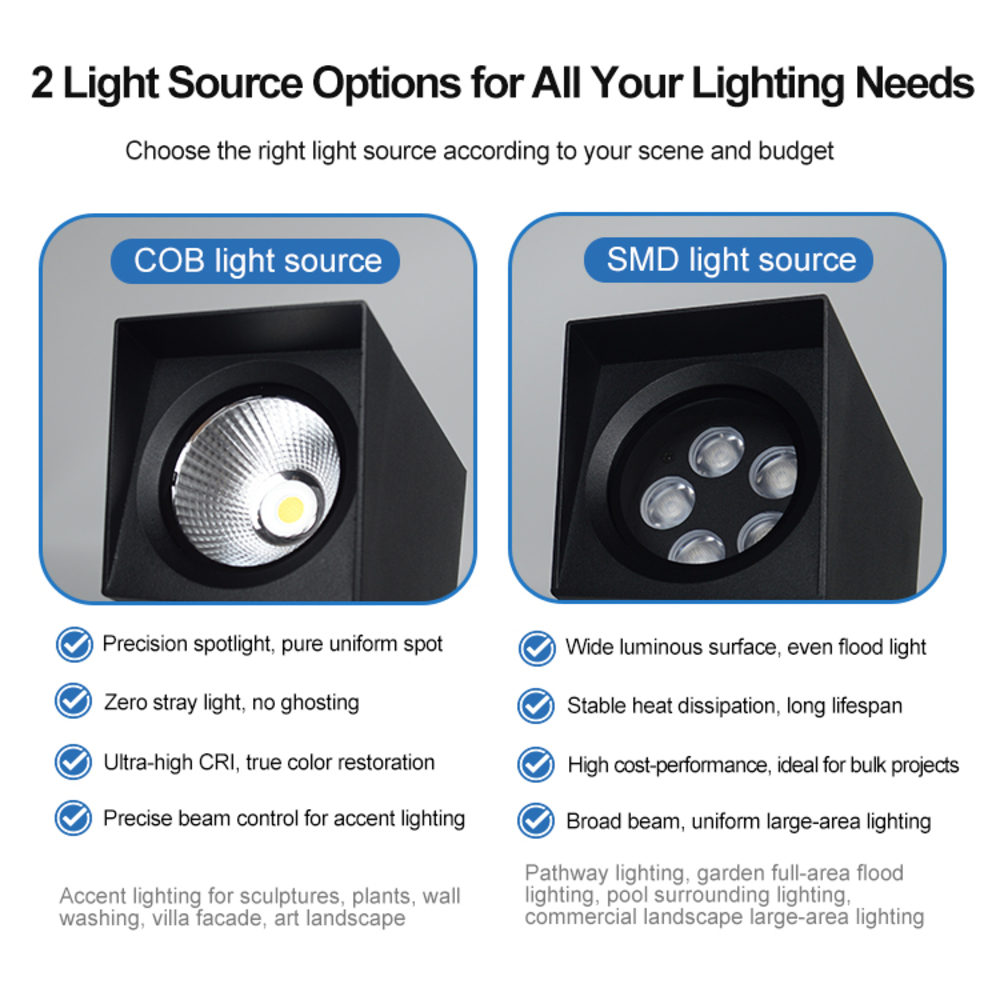
A COB (Chip-on-Board) LED integrates multiple LED chips into a single compact module, forming a high-density light-emitting surface.
Key Characteristics of COB LED Spotlights
- Single, uniform light source
- High brightness intensity
- Concentrated beam output
- Minimal visible LED points
- Smooth, glare-controlled illumination
COB technology is widely used in high-end landscape lighting, façade lighting, and spotlighting applications.
2. What Is an SMD LED Garden Spot Light?
SMD (Surface-Mounted Device) LEDs consist of multiple individual LED chips mounted on a circuit board, each acting as a separate light source.
Key Characteristics of SMD LED Spotlights
- Multiple visible LED chips
- Wider light distribution
- Flexible color options (RGB available)
- Higher luminous efficiency (lm/W)
- More uniform area lighting
SMD is commonly used in general outdoor lighting, decorative landscapes, and wide-area illumination.
3. COB vs. SMD: Core Technical Differences
| Feature | COB LED | SMD LED |
|---|---|---|
| Structure | Multiple chips in one module | Multiple individual chips |
| Light Output | Concentrated and intense | Wide and diffused |
| Beam Control | Excellent for spotlighting | Better for general lighting |
| Appearance | Smooth light surface | Multiple visible points |
| Heat Density | Higher (needs better cooling) | Lower, distributed heat |
| Efficiency | Slightly lower lm/W | Higher lm/W |
| Color Flexibility | Limited | Very flexible (RGB available) |
4. Brightness and Beam Performance
COB LED Advantages
COB LEDs produce high-intensity, focused beams, making them ideal for:
- Tree uplighting
- Architectural highlights
- Sculpture lighting
- Narrow beam applications
Because the light source is concentrated, COB fixtures achieve better beam control and deeper projection.
SMD LED Advantages
SMD LEDs provide wide-angle illumination, suitable for:
- Garden pathways
- Lawn lighting
- Ambient landscape lighting
They create a softer and more evenly distributed light field.
5. Outdoor Durability and Reliability
COB Performance Outdoors
- Requires strong heat dissipation due to high chip density
- Works best in high-quality aluminum housings
- Excellent when paired with proper thermal design
From product data, COB outdoor lights typically feature die-cast aluminum bodies and IP65 waterproof ratings .
SMD Performance Outdoors
- Lower thermal concentration improves stability
- Better suited for long operating hours
- More resistant to thermal stress
SMD fixtures generally have longer stability in continuous-use environments, especially for large-area lighting.
6. Energy Efficiency Comparison
SMD LEDs typically offer higher luminous efficacy (lm/W) than COB.
This means:
- Lower power consumption for the same brightness
- Better for large installations
- Reduced operating cost
COB LEDs, while powerful, focus more on intensity rather than efficiency.
7. Heat Dissipation Differences
Heat is critical in outdoor lighting performance.
- COB LEDs:
- High heat density
- Require larger heat sinks
- Sensitive to poor thermal design
- SMD LEDs:
- Spread heat across multiple chips
- Easier passive cooling
- More stable in long-term outdoor use
This makes SMD generally more forgiving in lower-cost fixtures.
8. Optical Design and Visual Comfort
COB:
- Smooth, uniform beam
- Less glare when properly shielded
- Ideal for professional architectural lighting
SMD:
- May produce multiple shadow points
- Can create glare if not diffused
- Better for ambient lighting rather than precision lighting
9. Application-Based Comparison
Best Applications for COB Square Garden Spot Lights
- Feature trees and statues
- Building façade highlighting
- Accent lighting
- Narrow beam projection
- High-end landscape design
Best Applications for SMD Square Garden Spot Lights
- Lawn illumination
- Garden pathways
- Decorative RGB lighting
- Wide-area flood lighting
- Residential outdoor spaces
10. Cost Comparison
| Type | Cost Level |
|---|---|
| COB LED | Medium to High |
| SMD LED | Low to Medium |
COB fixtures are typically more expensive due to:
- Higher chip density
- More complex thermal design
- Premium application focus
SMD lights are more cost-effective for large projects.
11. Lifespan and Maintenance
Both technologies can reach 30,000–50,000 hours, but performance depends on:
- Driver quality
- Heat management
- Waterproof sealing
Poor heat dissipation affects COB more significantly than SMD.
12. Smart Lighting and RGB Compatibility
SMD LEDs are superior for:
- RGB color-changing lighting
- Smart control systems
- Dynamic lighting effects
COB is typically limited to:
- Single color temperature
- Fixed lighting output
13. Which Is Better for Outdoor Use?
Choose COB LED Square Garden Spot Lights if:
- You need strong, focused lighting
- You are highlighting specific objects
- You want high-end architectural effects
- Beam precision is critical
Choose SMD LED Square Garden Spot Lights if:
- You need wide-area lighting
- Energy efficiency is a priority
- You want RGB or smart lighting
- You are working on large-scale projects
14. Professional Recommendation (Key Insight)
For most outdoor projects:
- Use COB for accent lighting
- Use SMD for general lighting
Many professional lighting designs combine both technologies to achieve the best result.
15. Final Comparison Table
| Criteria | COB LED | SMD LED |
|---|---|---|
| Brightness Intensity | ⭐⭐⭐⭐⭐ | ⭐⭐⭐ |
| Beam Focus | ⭐⭐⭐⭐⭐ | ⭐⭐ |
| Energy Efficiency | ⭐⭐⭐ | ⭐⭐⭐⭐⭐ |
| Heat Management | ⭐⭐⭐ | ⭐⭐⭐⭐ |
| Outdoor Stability | ⭐⭐⭐⭐ | ⭐⭐⭐⭐⭐ |
| Cost Efficiency | ⭐⭐⭐ | ⭐⭐⭐⭐⭐ |
| RGB Capability | ⭐ | ⭐⭐⭐⭐⭐ |
Conclusion
There is no universal “better” option between COB and SMD LED square garden spot lights. The right choice depends on your application, lighting design goals, and project budget.
- COB LEDs excel in precision, intensity, and architectural lighting
- SMD LEDs excel in efficiency, flexibility, and general illumination
For professional outdoor lighting projects, the most effective strategy is often combining both technologies to create layered lighting effects that are both functional and visually appealing.